


OTREC's Past Events
January 2014
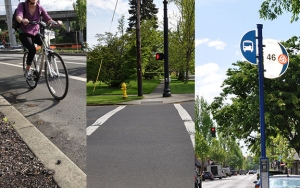
Pedestrian Crossings, Bicycling and Transit Stop Removal: 3 TRB annual meeting student presentations
January 10, 2014 12:00 pm - January 10, 2014 1:00 pm
Where: Room 204 of the Distance Learning Center Wing of the Urban Center at PSU
Speaker: Nick Foster, Christopher Muhs and Zef Wagner, Portland State University
Topic: Pedestrian Crossings, Bicycling and Transit Stop Removal: 3 Transportation Research Board annual meeting student presentations
Summaries: Evaluating Driver and Pedestrian Behaviors at Enhanced Multilane Midblock Pedestrian Crossings: Case Study in Portland, Oregon This study examines driver and pedestrian behaviors at two enhanced midblock pedestrian crossings in Portland, Oregon. One crossing is on a five-lane arterial with a posted speed of 35/45 miles-per-hour (MPH) and features six rectangular rapid flash beacon (RRFB) assemblies and a narrow median refuge. The other crossing is on a suburban arterial with four travel lanes and a two-way left-turn lane. The crossing is enhanced with four RRFB assemblies and a median island with a “Z” crossing, or Danish offset, designed to encourage pedestrians to face oncoming traffic before completing the second stage of their crossing. Approximately 62 hours of video have been collected at the two locations. A total of 351 pedestrian crossings are analyzed for driver compliance (yielding) rates, pedestrian activation rates, pedestrian delay, and conflict avoidance maneuvers. The suburban arterial crossing is also evaluated to determine its effectiveness at diverting pedestrians to cross at it instead of away from a crosswalk, as well as pedestrian compliance with the Z-crossing. This study finds that average driver yield rates at both sites are just over 90% when the RRFB is activated, which is consistent with previous studies. RRFB actuation rates range from 83% to over 90%. The results also show that approximately 52% of all crossings at the marked crosswalk at the second location are from diverted pedestrians and that the enhanced crossing captures about 82% of all crossings near the crosswalk. Finally, approximately 52%, of the pedestrians using the crosswalk follow the Z-crossing pattern through the median.
Bicycling Is Different: Built Environment Relationships to Nonwork Travel There is growing investment in infrastructure to support non-motorized travel modes in the United States, in particular for bicycling. However, there remains a dearth of knowledge on the relationships between built environments and bicycling for non-work transportation. This issue is exacerbated by researchers and practitioners continuing to combine walking and bicycling into the category “non-motorized modes,” despite the two having many differences. This paper addresses these shortcomings through a segmented analysis of mode choice and mode share for walking, bicycling, and automobile travel. The data used are from a 2011 establishment intercept survey in the Portland, Oregon region and are destination-based. Results show pronounced differences in the empirical relationships between walking and bicycling and the built environment, when controlling for aspects of the individual, site, and trip. Models for mode choice and mode share indicate that the built environment attributes that influence automobile and walk travel are similar; yet, their influence is in the opposite direction. Empirical relationships with the built environment are altogether different for bicycling trips. Socio-demographic variable results are consistent with much of the non-work mode choice literature, but trip distance is not. Trip distance has the expected relationship with walking, but does not have a significant relationship with bicycling. The findings on the built environment relationships with travel modes support a move away from combining walking and bicycling together as non-motorized transportation for analysis and planning. They also lend insight into additional considerations for future work in non-work transportation research and policy.
Benefit-Cost Evaluation Method for Transit Stop Removal The introduction of wider stop spacing through the removal or consolidation of existing stops is one method transit agencies can use to reduce travel time and reliability on many transit lines. A great deal of research has been done to provide tools for determining optimal stop spacing, but tools are still needed to help service planners determine the optimal stops to remove. Stop-level bus performance data provide the information needed to develop a method for assessing the total benefits and costs to riders of removing individual stops. This tool compares the benefit to through-riders in terms of travel time savings with the additional access cost to riders using the stop. The tool was applied to a bus route in Portland, Oregon, using stop-level ridership data from TriMet, the regional transit agency. The case study identifies three stops with very high benefit-cost ratios and discusses the effects of removing those stops. A sensitivity analysis is performed to show the effect of changing the value of time factor or the assumed time savings from each stop removal. Further research needs are identified and tradeoffs are discussed regarding the use of this tool. Overall, the assessment tool provides a relatively simple way for transit service planners to identify ideal stops for removal or consolidation.
Stream the seminar live, or watch an archived video, when made available, through the link here.
Add this event to your calendar:

December 2013
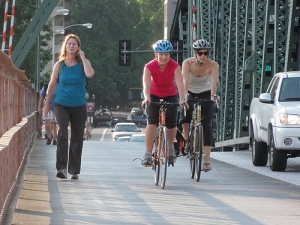
Peak Pedaling: Has Portland Bicycling reached the Top of the Logistic Curve?
December 6, 2013 12:00 pm - December 6, 2013 1:00 pm
Where: Room 204 of the Distance Learning Center Wing of the Urban Center at PSU
Speaker: Robert McCullough, McCullough Research
Topic: Peak Pedaling: Has Portland Bicycling reached the Top of the Logistic Curve?
November 2013
Piloting Portland’s MultiModal Arterial Performance System
November 22, 2013 12:00 pm - November 22, 2013 1:00 pm
Where: Room 204 of the Distance Learning Center Wing of the Urban Center at PSU
Speaker: Shaun Quayle, Kittelson & Associates, Inc.
Topic: Piloting Portland's MultiModal Arterial Performance System
Stream the seminar live, or watch an archived video, when made available, through the link here.
Add this event to your calendar:
Special Seminar: An Analytical Derivation of the Capacity at Weaving Sections
November 20, 2013 11:00 am - November 20, 2013 12:30 pm
Where: ITS Lab, Room 315, PSU Engineering Building
Speaker: Florian Marczak, LICIT, IFSTTAR/ENTPE, University of Lyon
Transportation: From Here to There; How and Who Pays
November 19, 2013 7:00 pm - November 19, 2013 9:00 pm
Where: Multnomah County Building Board Room 501 SE Hawthorne Boulevard
Speakers: George Beard, Alliance Manager, Office of Research and Strategic Partnerships, PSU
Mark Frohnmayer, Oregon Transportation Commission, President, Arcimoto Co.
Carlotta Collette, Metro Councilor, Chair of Joint Policy Advisory Committee on Transportation (JPACT)
Tobias Read, Oregon State Representative, Chair of House Committee on Transportation and Economic Development
Topic: Transportation: From Here to There; How and Who Pays
Summary: The Portland and Oregon ground transportation system is funded and managed by an overlapping, complex series of intergovernmental arrangements including the federal government, state government, local governments and the Metro regional government. What do these intergovernmental arrangements look like? Who’s the leader? When and Why? Do these arrangements impede or facilitate transportation problem solving? What are some ideas for the future? Listen, learn and question these experts, representing our state transportation management and legislative infrastructure, our Metro government and a view of the future.
For more information contact: Ann Mulroney, League of Women Voters of Portland: [email protected]
Cyclist Compliance at Signalized Intersections
November 15, 2013 12:00 pm - November 15, 2013 1:00 pm
Add this event to your calendar:
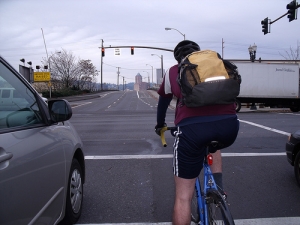
Why doesn’t that traffic signal ever turn green? An evaluation of roadway markings for cyclists
November 8, 2013 12:00 pm - November 8, 2013 1:00 pm
Where: Room 204 of the Distance Learning Center Wing of the Urban Center on the Portland State University campus
Speaker: Stefan Bussey, PSU CEUG Honors Student
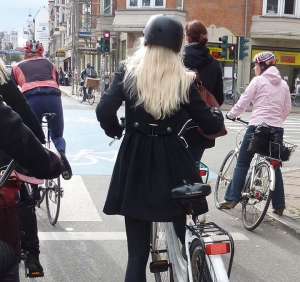
Topic: Why doesn’t that traffic signal ever turn green? An evaluation of roadway markings for cyclists
Summary: Signalized intersections often rely on vehicle detection to determine when to give a green light. The 2009 Manual of Uniform Traffic Control Devices (MUTCD) includes an on-pavement marking and curbside sign that public agencies can use to indicate where cyclists should position themselves while waiting at an intersection. This presentation reviews the effectiveness of current markings, signs, and other methods used to help cyclists properly position themselves over detection.
*image by Greg Raisman
Stream the seminar live or watch an archived video, when made available, through the link here.
Add this event to your calendar:
Clouds, Crowds, and Traffic: What 10 emerging Megatrends mean for the future of transportation
November 1, 2013 12:00 pm - November 1, 2013 1:00 pm
Where: Room 204 of the Distance Learning Center Wing of the Urban Center on the Portland State University campus
Speaker: Ted Trepanier, INRIX, Inc.
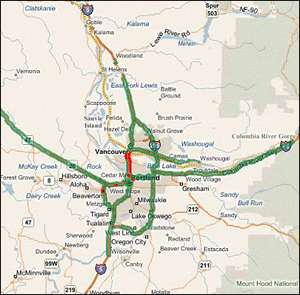
Topic: Clouds, Crowds, and Traffic: What 10 emerging Megatrends mean for the future of transportation
October 2013
Congestion Modeling and Mitigation in the National Airspace System
October 25, 2013 12:00 pm - October 25, 2013 1:00 pm
Where: Room 204 of the Distance Learning Center Wing of the Urban Center on the Portland State University campus
Speaker: David Lovell, Associate Professor, University of Maryland
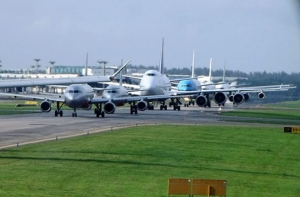
Topic: Congestion Modeling and Mitigation in the National Airspace System
Add this event to your calendar:
E-Bikes in the United States
October 18, 2013 12:00 pm - October 18, 2013 1:00 pm
Where: Room 204 of the Distance Learning Center Wing of the Urban Center on the Portland State University campus
Speaker: John MacArthur, Sustainable Transportation Program Manager, OTREC at PSU
Topic: E-Bikes in the United States

Transportation Analysis Informing Transportation Planning and Policy at ODOT
October 11, 2013 12:00 pm - October 11, 2013 1:00 pm
Where: Room 204 of the Distance Learning Center Wing of the Urban Center on the Portland State University campus
Speaker: Alexander Bettinardi, Oregon Department of Transportation
Topic: Transportation Analysis Informing Transportation Planning and Policy at ODOT
Using empirical (real-world) transportation data to extend travel demand model capabilities
October 4, 2013 12:00 pm - October 4, 2013 1:00 pm
Where: Room 204 of the Distance Learning Center Wing of the Urban Center on the Portland State University campus
Speaker: Michael Mauch, Ph.D., Senior Data Analyst, Project Manager, DKS Associates
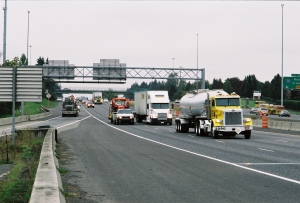
Topic: Using Empirical (real-world) Transportation Data to Extend Travel Demand Model Capabilities
August 2013
Growing a World-Class Cycling Culture: Lessons from Quebec (Ann Niles Transportation Lecture)
August 26, 2013 6:30 pm - August 26, 2013 7:30 pm
Where: Lincoln Recital Hall, Lincoln Hall, Portland State University, 1620 S.W. Park Ave.
Admission: Free, but space is limited to 240 people.
Sponsors: Initiative for Bicycle and Pedestrian Innovation (IBPI) and Portland State University School of Music

Transportation 2.0
August 26, 2013 8:00 am - September 6, 2013 11:59 pm
Where: Online
Presenter: Joshua Skov, Principal and Co-Founder of Good Company
How can we meet our transportation needs more sustainably? What changes are already taking place as a result of markets and technology? Where do we need policy to foster better outcomes? And, what are the sustainable transportation opportunities for businesses, the public sector, and households?
This online workshop, offered by the UO Sustainability Leadership Program, reviews the evolution of transportation from technological, social and public policy perspectives. The content will explore sustainability issues and opportunities related to the transformation underway, in how we provide, plan, and deliver transportation services and systems.
MetroMile is sponsoring full and partial scholarships for this workshop. Contact Jake Pollack, UO Sustainability Leadership Program Manager, [email protected] for an application by August 12.
MetroMile, a San Francisco startup which markets and sells auto insurance priced according to how much customers drive,raised $10 million this spring, following a previous $4 million fundraising round. The company, which launched service in Oregon in December, provides drivers with a proprietary device called the Metronome. Once plugged into a vehicle's telematics system underneath the dashboard, the Metronome counts miles and also provides data useful in planning trips and improving gas mileage.
For more information, Transportation 2.0 course content and registration visit: http://sustain.uoregon.edu/workshops/course_desc.php?CourseKey=670950
Add this event to your calendar:

Comprehensive Bicycle Planning & Design Course (IBPI)
August 26, 2013 7:30 am - August 30, 2013 5:00 pm
The field of bikeway planning is rapidly evolving. This course will bring you up to speed on the cutting edge in practice and research, offering valuable skills for your professional life. It will cover the fundamentals of bikeway planning and design through an intensive week of interactive classroom and field experience. Instructors will integrate transit access and connections, bridges, trail crossings, and other special features into discussions, while using project examples to highlight practical applications of the principles and techniques covered. Effective education and encouragement programs, including public involvement strategies, will also be discussed.
Upcoming Events Snapshot
- August 18th, 2014 - Evaluating the Level-of-Service of Protected Bike Lanes
- August 25th, 2014 - Comprehensive Bicycle Design & Engineering 2.0
- September 15th, 2014 - 2014 Oregon Transportation Summit