


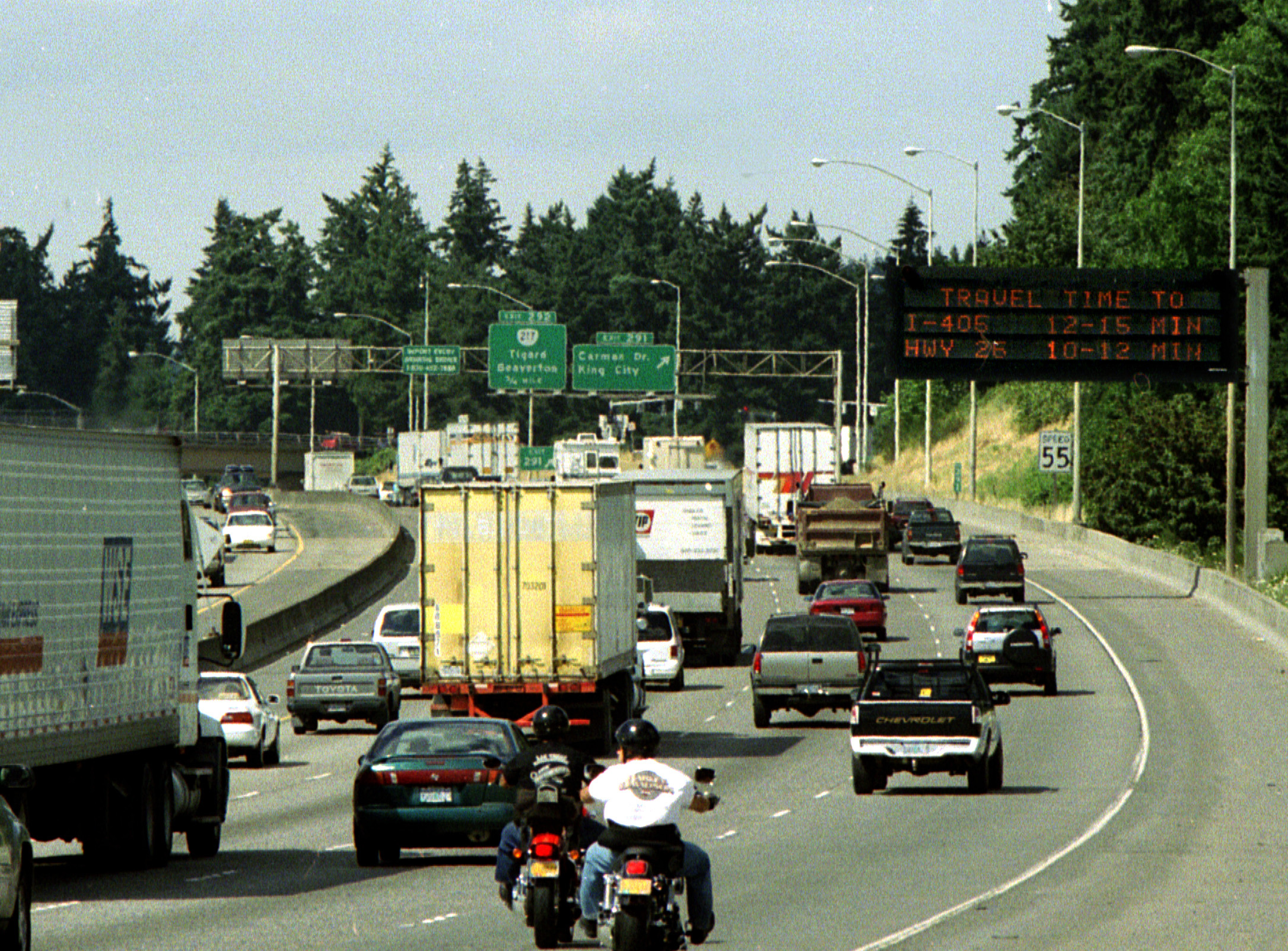
Analysis of Travel Time Reliability for Freight Corridors Connecting the Pacific Northwest
Principal Investigator
Miguel Figliozzi, Portland State University Civil & Environmental Engineering
Final Report
 OTREC-RR-12-11 Analysis of Travel-Time Reliability for Freight Corridors Connecting the Pacific Northwest [January 2014]
Final Report
OTREC-RR-12-11 Analysis of Travel Time Reliability for Freight Corridors Connecting the Pacific Northwest [June 2014]
Summary
Due to its geographic location, Oregon's economy is highly dependent on reliable transportation. Recent studies indicate that projected growth in freight and passenger traffic will significantly increase congestion and travel time delays. Further, it is predicted that congestion may result in a potential income loss valued at $1.7 billion annually in value added generated in Oregon by 2025, and a loss of 16,000 ongoing jobs(ERDG, 2005, ERDG, 2007). Most supply chains cannot thrive without access to an efficient and reliable freight system. Since congestion in the highway system has a significant impact on the productivity and competitiveness of the Pacific…
Due to its geographic location, Oregon’s economy is highly dependent on reliable transportation. Recent studies indicate that projected growth in freight and passenger traffic will significantly increase congestion and travel time delays. Further, it is predicted that congestion may result in a potential income loss valued at $1.7 billion annually in value added generated in Oregon by 2025, and a loss of 16,000 ongoing jobs(ERDG, 2005, ERDG, 2007).
Most supply chains cannot thrive without access to an efficient and reliable freight system. Since congestion in the highway system has a significant impact on the productivity and competitiveness of the Pacific Northwest Economy, the objective of this research is to evaluate travel time reliability in the main freight corridors connecting the Pacific Northwest to California, the Midwest, and Southwest.
Statistical analysis of Global Positioning System (GPS) commercial vehicle travel data will be used to study travel time reliability and identify congestion chokepoints affecting corridors to/from the Pacific Northwest. GPS data will be used to determine travel time distributions along different corridors by corridor segment (connecting main cities along the corridor), time of day, and day of week. Unlike previous studies, (a) GPS data will be complemented with detector and transponder based information to improve the accuracy of the travel time estimations in urban areas and to compare measurements and (b) the impact of travel time variability by time of day will be tested using methodologies from the Operations Research (OR) literature.
A major objective of the project is to quantify travel time reliability on I-5 and I-84 freight corridors connecting major regional origin-destinations that start, end, or run through Oregon.
Project Details
Year: 2009
Project Cost: $65,000
Project Status: Completed
Start Date: September 1, 2008
End Date: March 30, 2011
Theme:
TRB RiP: 17985
Share: 

Search Research Projects and Reports
Products
-
Multi-Criteria Trucking Freeway Performance Measures in Congested Corridors
- JOURNAL
-
Algorithms to Study the Impacts of Travel Time Reliability Along Multi-Segment Trucking Freight Corridors
- JOURNAL
-
OTREC-RR-12-11 Analysis of Travel-Time Reliability for Freight Corridors Connecting the Pacific Northwest
- FINAL_REPORT
-
OTREC-RR-12-11 Analysis of Travel Time Reliability for Freight Corridors Connecting the Pacific Northwest
- FINAL_REPORT
OTREC by the Numbers
- Total value of projects funded: $12.2 million
- Number of projects funded: 153
- Number of faculty partners: 98
- Number of external partners participating in OTREC: 46