


Innovative look at effects of bottlenecks wins Transportation Research Forum award
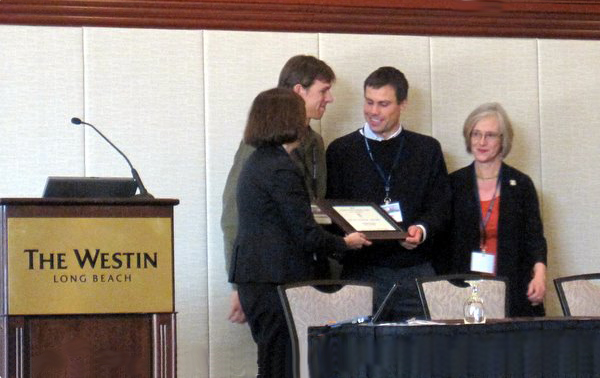
OTREC researchers at Portland State University won the best paper award at the annual Transportation Research Forum for examining the effects of freeway traffic bottlenecks on costs. Graduate student Alex Bigazzi and Miguel Figliozzi, an associate professor of Civil and Environmental Engineering, submitted the paper for the forum, held in March in Long Beach, Calif.
Traffic flows can break down more or less at random as the freeway approaches its capacity. Although drivers pay a high price for bottlenecks both in their time and fuel costs, earlier models have taken an oversimplified look at how the uncertainty associated with how bottlenecks form, and how long they last, affect time and fuel costs. Without incorporating uncertainty, previous models underestimate the impact of congestion and bottlenecks. The paper, called “A Model and Case Study of the Impacts of Stochastic Capacity on Freeway Traffic Flow Benefits and Costs,” takes into account the range and frequency with which these random or uncertain traffic breakdowns occur.
Research detailed in the paper stemmed from an OTREC project, Value of Reliability. Figliozzi had considered the concept of reliability for years, even using it in his modeling class as an example on how to analyze the impact of uncertainty and combine diverse datasets and models—traffic, congestion, and emissions—into a cohesive model.
In terms of time and fuel costs, an unreliable freeway is a costly one to take, Figliozzi said. “If you know with certainty that congestion is going to add an extra 10 minutes, that’s a cost that is less than if you know that congestion can add anything between five minutes and a half hour. Even though on average it takes 10 minutes, that’s totally different.”
Bottlenecks don’t just waste time, Figliozzi said, they also burn up more fuel as drivers transition quickly from free-flow driving to stop-and-go conditions. This also increases carbon dioxide emissions and air pollution.
The paper could help policymakers justify or prioritize remedies that reduce system unreliability even though if the improvements are in segments which aren’t the busiest. “When you have to prioritize the use of public funds, do you apply that to a freeway that is reliable versus one that is unreliable?” Figliozzi said. “When analyzing the allocation of transportation funds, all things being equal, if you can improve reliability without increasing capacity or reducing demand, you can get more return for the buck.”
Click here to read the full paper.
Tags: alex bigazzi, bottlenecks, freeway capacity, miguel figliozzi, reliability
Share: 


Send to a Friend
Archives
Categories
Filter By University
- Portland State University
- University of Oregon
- Oregon State University
- Oregon Institute of Technology
OTREC's Most Used Tags
alex bigazzi annual report bicycle bicycle infrastructure bicycling chris monsere cutc design electric vehicles hau hagedorn hiring ibpi its lab jennifer dill john macarthur karen dixon kelly clifton kristin tufte lisa diercksen livability livemove marc schlossberg meeting miguel figliozzi newsletter nico larco oregon department of transportation oregon transportation summit otrec peter dusicka portland state university proposals public transportation region x region x consortium rfp rita robert bertini sam adams step sustainable cities initiative transit transportation research board trb trimet utc visiting scholar program visiting scholars program walking yizhao yang